Position and effect
Light, shadow and lighting at night
On Mallorca the sun stands high and hard for much of the year. For sculpture that is better than the flat light of central Europe, because it draws form sharply.
It does have an hour at midday in which every object goes flat.
Orientation by the day, not by the ground plan
What counts is the hour you are actually outside. If you sit on the terrace in the evening, you orient the work by the light at seven, not by the symmetry of the garden. Raking light in the late afternoon is what shows a surface. Raking light means the sun meets the surface at a shallow angle, so that every unevenness throws a small shadow of its own.
North-facing sides are not bad, they are quieter. Polished surfaces are better off there, because they do not glare.
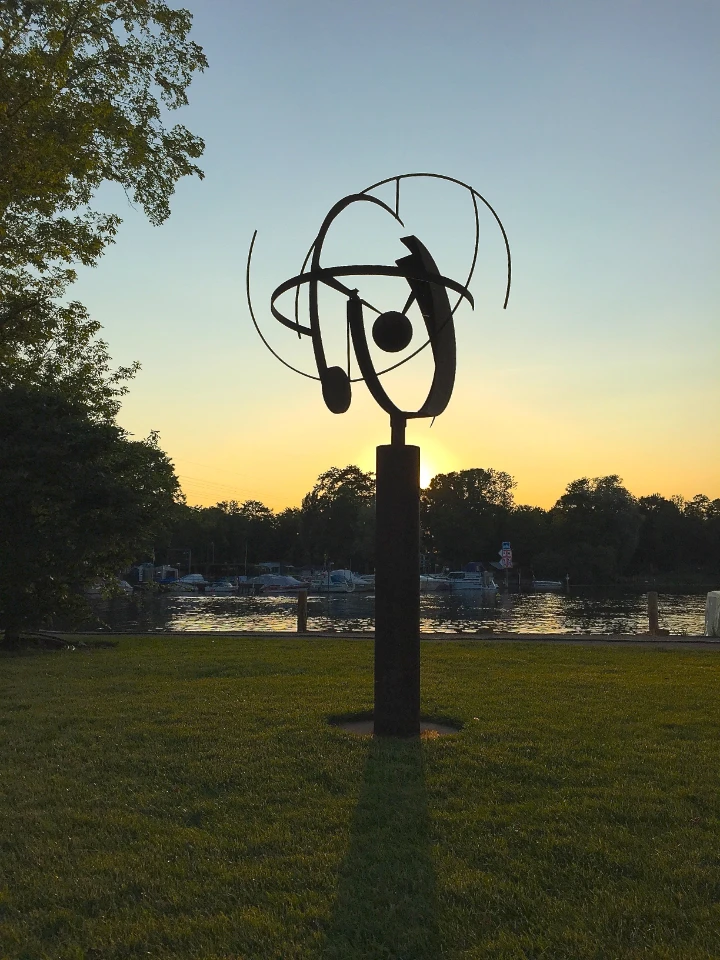
Michael Ernst | kinetic sculpture | steel
Photo: Sculpture Mallorca / Rolf Herbert Zscharnack
Lighting
One spotlight, set low, from the front at an angle. Not three of them, and not from directly below, which produces theatre.
Warm white, 2700 to 3000 Kelvin. Cold light turns bronze grey and stone dead.
At least […] metres belong between spotlight and object, otherwise the first surface it strikes burns out.
The shadow the work throws on a wall is often stronger than the lit object itself. That can be planned: the spotlight further out, the wall behind it.
What we do
At the installation we tell you where the spotlight belongs, and if needed we come back once in the evening. That is part of the delivery, not an extra.
Where the spotlight goes is settled on the day of installation.